Reflections from the High Touch High Tech pilot in the Philippines.
What does it take to introduce new approaches to teaching in real classrooms?
For Levi Miscala and Aica Sta. Isabel – both former teachers and members of the High Touch High Tech (HTHT) implementation team in the Philippines – the answer goes beyond technology.
Their experiences working alongside public school teachers in Zambales point to something more fundamental: trust, adaptation, and the systems that support change.

Levi Jun Miscala is a program leader at Ayala Foundation.
The first time we told a teacher she was doing enough, she cried.
It was a simple sentence – Ma’am, you did good. How did you feel? – offered during a check-in after a HTHT classroom observation. We hadn’t planned it. But Ma’am Esthefanie, a public school teacher in Zambales, broke into tears. And in that moment, something inside me softened too.
I realized then that this digital education program we were piloting – while on the surface about tools, training, and timelines – was never just about technology. Instead, it was about tenderness. It was about trust. It was about the pain so many teachers carry, and how rarely people see it.
When Aica and I joined the HTHT implementation team in the final months of the pilot, we shared something important: we had both been public school teachers. We leaned into that, listening, checking in, and asking teachers how they were doing – not just how the program was going – knowing that what we were asking of them was not small.
Teachers were navigating learning gaps, new tools, and pressure to adapt. For many, professional development had come to feel like another demand. We wanted this to feel different.
Over time, that difference showed in small ways. Teachers began to open up, to reflect more honestly, to try new approaches in their classrooms. They didn’t just implement the program – they shaped it.
We talk a lot about scale, impact, and sustainability. But in Zambales, what made those things possible wasn’t built in strategy decks. It was built in small moments – conversations, coaching sessions, quiet affirmations.
In making teachers feel seen.
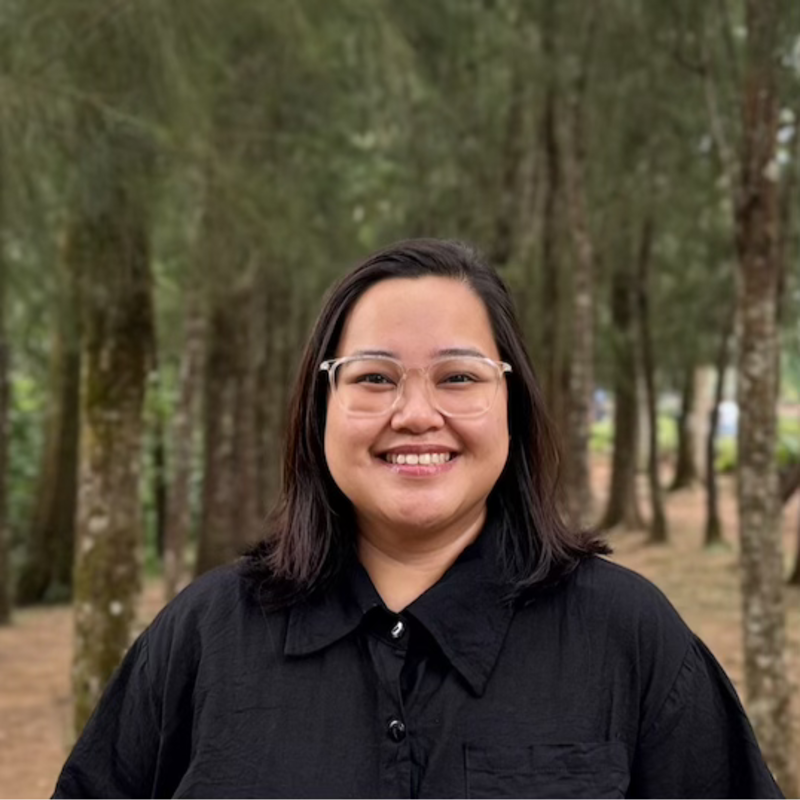
Aica Sta. Isabel is project support for education at Ayala Foundation.
As I write this, I’m marking my first year at Ayala Foundation – one filled with learning, unlearning, and growth I didn’t quite expect. It was also through this role that I had the opportunity to work on the CENTEX High Touch High Tech (HTHT) program in the Philippines.
What a year it has been.
Before this, my work in education was always at the ground level – teaching in a public school, then supporting students in a university setting. In those roles, I worked closely with learners. But HTHT shifted my perspective in a completely new way.
This time, I wasn’t leading the classroom; I was working alongside teachers. I saw firsthand what it meant to support them as they began integrating technology into their teaching – and how they made HTHT their own.
To be honest, the first few months were difficult. We were a lean team supporting multiple schools across different contexts, with limited time and resources. We were building as we went – adjusting timelines, refining approaches, and figuring out how to meaningfully support schools in real time.
And yet, it was through these challenges that the biggest lessons emerged.
Every teacher approached HTHT differently. Some leaned into the technology right away. Others made smaller but meaningful shifts to keep their classrooms student-centered. There wasn’t just one way to do HTHT – and that was the beauty of it.
HTHT offered a framework, not ready-made solutions. Teachers used adaptive tools and student data to better understand where their students were, and to adjust their teaching accordingly. In their hands, that framework became something flexible that could respond to the needs of their classrooms.
But even the most thoughtful program won’t thrive without the right support.
One of the biggest realizations I had this year was how important school leadership and community involvement are. In schools where principals were actively engaged – checking in, supporting teachers, making adjustments – we saw real momentum. In some cases, support extended beyond the school, with local actors helping set up devices and prepare classrooms for digital learning.
These efforts were often behind the scenes, but they made a visible difference.
This experience has shown me that scaling change in education is complex and deeply human. It requires systems thinking, but also empathy, patience, and the willingness to keep learning alongside the people you’re trying to support.
And it always comes back to teachers.
Despite limited resources and high demands, they continue to adapt, create, and show up for their students. When they are supported, trusted, and heard, they don’t just implement new approaches – they make them work in ways that are meaningful for their classrooms.
Together, their reflections point to a simple but often overlooked reality: change in classrooms depends on more than new tools or models. It depends on how teachers are supported to make those approaches work in their classrooms.
Results from HTHT pilots reinforce this. In the Philippines, students gained the equivalent of four additional months of learning in just 12 weeks of instructions. In Cambodia, students achieved approximately eight additional months of learning over eight months, alongside increased use of differentiated, student-centered teaching practices.
These results didn’t happen in isolation: they were shaped by how teachers engaged with the approach, and the support they received.