How the Delivery Toolkit translates evidence into practical guidance to help governments strengthen implementation, so education reforms deliver measurable learning gains in the classroom.
Author: Neelofar Javaid
This post was originally published by Global Partnership for Education.
What began as a global research initiative funded by the U.K. Foreign, Commonwealth & Development Office (FCDO), DeliverEd, under the Education Commission (now The Learning Generation Initiative, or LGI) has evolved into a practical delivery toolkit designed to address one of education’s biggest challenges: implementing reforms effectively.
Why a Delivery Toolkit?
Drawing on in-depth research in Ghana, Jordan, Pakistan, Sierra Leone and Tanzania, DeliverEd sought to understand how governments can deliver better outcomes by improving how policies are executed through delivery approaches.
Following the DeliverEd report: Deliberate Disruptors: Can Delivery Approaches Deliver Better Education Outcomes?, governments requested a practical tool that they could use.
In response, LGI developed the Delivery Toolkit designed to translate the research findings into practical action.
The Delivery Toolkit is not intended as a standalone solution. Rather, it is an adaptable, evidence-based support mechanism that helps strengthen governments’ existing systems and priorities by enhancing planning, coordination, and performance management.
Its purpose is to help ministries translate their reform commitments into measurable improvements in learning outcomes.
Why it matters
Many governments have ambitious education reform agendas. However, translating policies into real classroom change is difficult – especially when systems face resource constraints, limited implementation capacity, and weak coordination – often resulting in gaps between intent and outcomes.
This is where strong delivery systems matter. The Delivery Toolkit was developed to help governments strengthen their delivery systems. It offers a practical, evidence-based roadmap to plan, implement, and sustain education reforms through the establishment or strengthening of delivery approaches and units.
What are delivery approaches and delivery units?
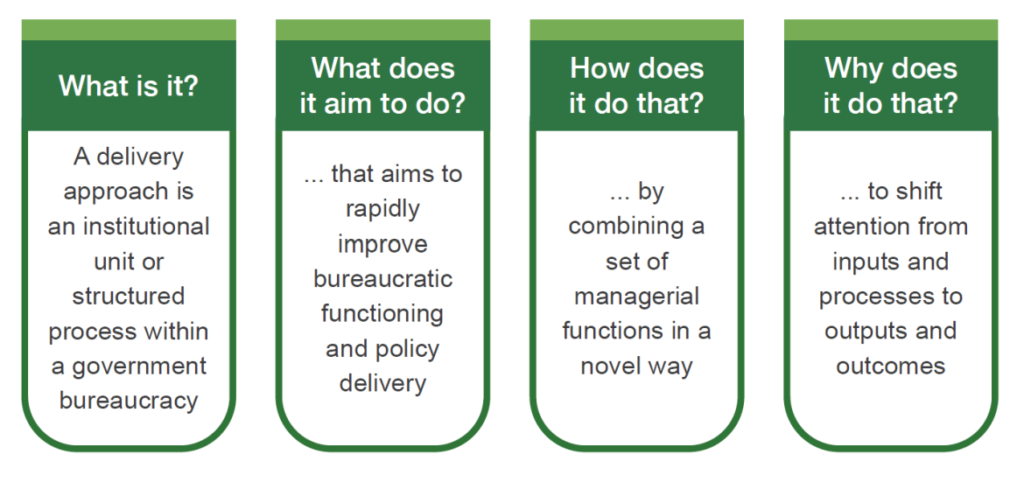
Delivery approaches and units are strategies used by governments to rapidly improve policy implementation by combining key managerial functions: setting targets, monitoring performance, and solving problems in real time, in focused and often novel ways.
They typically aim to shift attention from inputs and processes toward outputs and outcomes.
To implement delivery approaches, many governments establish delivery units. Often close to leadership and located at the heart of government (for example, within ministries or in the prime minister’s office), they are usually small, and tasked with driving reform priorities, coordinating across agencies, with clear focus on monitoring progress toward key targets, thus driving accountability.
Together, delivery approaches help bridge the gap between policy and practice, ensuring that education reforms lead to measurable improvements in student learning. DeliverEd defines a delivery approach in the following way:
What did we learn through our research?
DeliverEd’s research shows delivery approaches can strengthen prioritization, coordination, data use, and accountability at central levels, but didn’t focus sufficiently on learning outcomes and often struggle to shift problem-solving and behavior where implementation happens – in schools and across the middle-tier.
The toolkit focuses on linking leadership priorities to school-level realities and equipping the middle tier to bridge policy and practice.
What the Delivery Toolkit contains
The Delivery Toolkit includes a user-friendly guidance and a checklist to help governments establish or refine a delivery approach.
By strengthening delivery systems, clarifying priorities, and improving execution, the toolkit supports more effective reform implementation and contributes to improved student learning outcomes.
The toolkit is structured around the Launch, Learn, Sustain & Scale framework and provides step-by-step guidance to move from planning to implementation:
- Design and Launch: Diagnose delivery challenges and bottlenecks, engage stakeholders, and establish structures.
- Learn: Use data and real-time feedback to refine strategies, adapt reforms, and guide decisions.
- Sustain and Scale: Institutionalize effective practices for long-term impact.
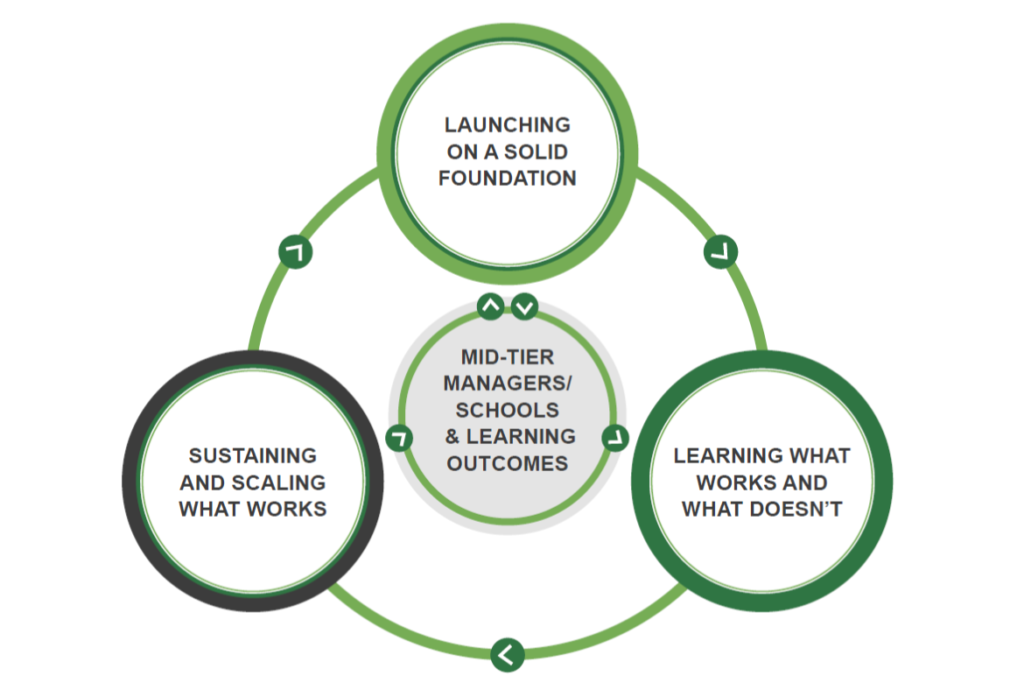
This process is iterative, allowing each country to focus on the stage most relevant to its context, as countries are at different points in developing their delivery approaches.
How GPE has helped
The Global Partnership for Education (GPE) played an instrumental role in the toolkit development. GPE was part of the LGI’s advisory group alongside the World Bank, FCDO, UNESCO International Institute for Educational Planning (UNESCO-IIEP), and Delivery Associates, helping review and discuss content as it was developed.
While building on DeliverEd country experiences, drawing on different partners’ perspectives also helped shape the toolkit’s structure and relevance to different real-world education system needs.
The Delivery Toolkit aligns with GPE’s approach to system transformation. As GPE supports governments to focus on implementing priority education reforms, align partners behind these country-owned reforms, and strengthen sustainable financing, the toolkit offers practical routines that can help national leaders and key stakeholders champion and steer the reform efforts with fidelity.
For instance, the toolkit can strengthen reform coordination by helping governments align key actors along the delivery chain. It can support a disciplined focus on problem-solving to address bottlenecks hindering public service delivery.
It can also reinforce progress monitoring and the use of data through structured routines for tracking progress, enabling evidence-based decision-making, and fostering continuous learning and adaptation — all core aspects central to GPE’s system transformation agenda.
Where we are now
The Delivery Toolkit is currently being piloted in Pakistan (Sindh) and Sierra Leone, with plans to add other locations.
- In Sierra Leone, the education ministry is using the Delivery Toolkit to refine its delivery approach for implementing the foundational learning strategy.
- In Pakistan (Sindh), the government has formally established a dedicated delivery section within the Reform Support Unit of the Sindh Education and Literacy Department to drive priority reforms.
Through the pilot, we aim to test, refine, and strengthen the toolkit, ensuring its routines and tools are practical, easy to integrate, context-responsive, and aligned with real implementation needs.
We also aim to capture and synthesize lessons from the pilot to inform the final toolkit and guide future support to partner governments implementing reform priorities.
Looking ahead
LGI will continue to support more effective delivery and will focus on building strong, data-driven decision-making cultures and embedding effective delivery mechanisms across all levels of the education system.
This includes strengthening system leadership, so education systems function as agile, collaborative learning organizations, while promoting inclusion and equity across all aspects of system delivery.
The goal is to foster systems that can launch reforms, learn and improve over time, and sustain change – ultimately helping ensure that every child has the opportunity to learn.
Interested in learning more?
We are interested in partnering with governments, policy makers, and education reform leaders, particularly in countries seeking to enhance education system performance through delivery-focused approaches.
International development partners and donors, as well as education experts and data analysts, may also benefit from integrating the toolkit and checklist into their work.
Please reach out to Deborah Kimathi (dkimathi@edc.org) or Neelofar Javaid (njavaid@edc.org). You can access the Delivery Toolkit and checklist, and we would be happy to explore opportunities to adapt it to your country’s reform agenda.
Photo: Mehreem Hashim, 12, in science class. She’s in grade 6 in the afternoon school program for girls at the Government Girls Primary School Nishtar Colony, Lahore, Pakistan
Credit: GPE/Sebastian Rich/CC-BY-NC-ND 2.0